
On November 16, the “UN-Habitat (Sub-Saharan Africa) Training Program on Urban Planning and Resilient Infrastructure Construction”, organized by the Ministry of Commerce and undertaken by the MOFCOM Training Base for International Business Officials (Shanghai), successfully conducted its field study session. Thirty-six officials from UN-Habitat and the ministries responsible for living environment, urban planning, and housing from countries including Benin, Mali, Gabon, Comoros, Burkina Faso, Senegal, Republic of the Congo, and Democratic Republic of the Congo visited the Shanghai People’s City Practice Exhibition Hall, the Yangpu Riverfront Public Space, and the “Green Hill” Ecological Complex. They delved into exploring the construction principles behind the “People’s City” concept.
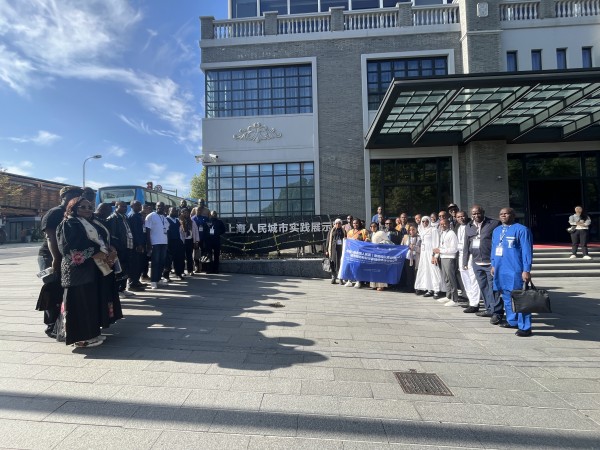
(Participants posing for a group photo at the Shanghai People’s City Practice Exhibition Hall)
At the People’s City Practice Exhibition Hall, participants gained an immersive understanding of Shanghai’s innovative practices in urban regeneration and public service enhancement through the circular model and interactive screens. Subsequently, the delegation conducted a field investigation along the riverfront promenade, showing keen interest in the multi-functional “Renren Wu” station that integrates amenities for rest, drinking water, and reading. Its “Urban Living Room” concept sparked lively discussions. The final stop of the visit was the “Green Hill” Ecological Complex, a successful transformation of a former tobacco warehouse. Participants focused on investigating its vertical greening system and the application of low-carbon technologies, praising it highly as an exemplary model that perfectly integrates industrial heritage revitalization with ecological principles. They considered it a highly valuable reference for sustainable urban renewal in African countries.
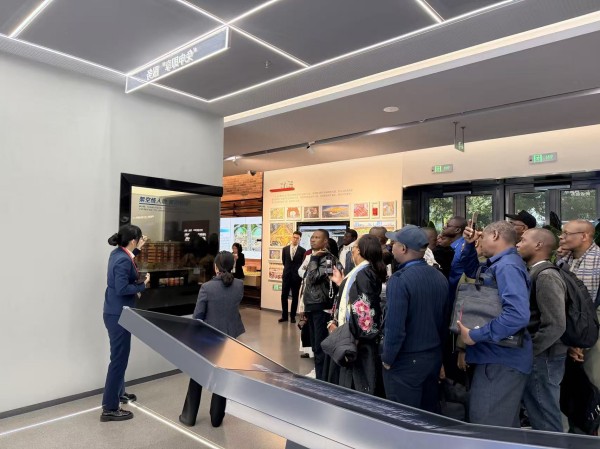
(Participants engaging in interactive exchange)
Mr. Ahmed Abdallah Chamsoudine from the Ministry of Youth and Sports of Comoros remarked: “The Shanghai People’s City Practice Exhibition Hall left an extremely deep impression on me. I profoundly felt a governance logic that is centrally guided by the needs of the people. This made me realize that outstanding urban development requires not only a forward-looking vision but also the establishment of an operational and evaluable implementation system.
Ms. Anne Flore Sylvie Ampouet Périgny, Director General of Urbanization and Land Planning from the Ministry of Urbanization and Land Planning Development of Gabon, reflected: “Against the backdrop of the magnificent Yangpu Bridge, the ‘Renren Wu’, though small, is a warm space that embodies the city’s meticulous care for every individual. It made me deeply understand that the warmth of a great city is precisely reflected in such detailed and inclusive public services. This is not merely an improvement in infrastructure but also the creation of a sense of ‘home’, significantly enhancing citizens’ sense of belonging and happiness.”
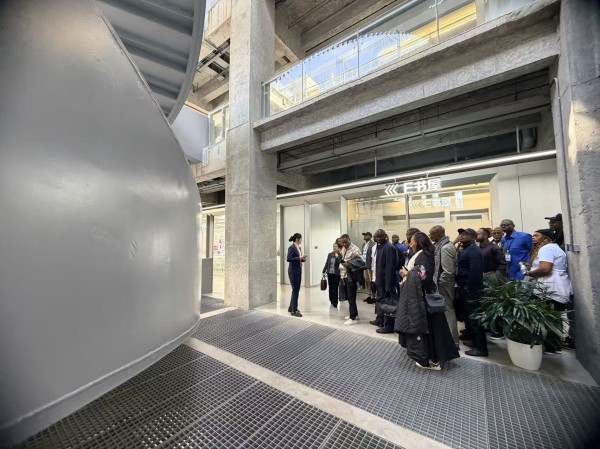
(Participants investigating the Green Hill Ecological Complex)
The successful implementation of this training program benefited from the strong support of the Ministry of Housing and Urban-Rural Development. Shanghai’s urban development practices fully demonstrate the core connotation of the “People’s City” philosophy——ensuring that the fruits of development benefit all citizens. In the future, China will continue to support African countries in enhancing their modern urban governance capabilities through various means such as technical training and planning cooperation, jointly advancing the implementation of the UN 2030 Agenda for Sustainable Development.
Written by: Liu Liu
Photographed by: Liu Liu
Reviewed by: Chen Wei