
On May 26, 2026, the Seminar for Developing Country State-Owned Enterprise (SOE) Executives, sponsored by the Ministry of Commerce (MOFCOM) and organized by the MOFCOM Training Base for International Business Officials (Shanghai) at Shanghai Business School (SBS), visited Jingdezhen, the millennium-old porcelain capital, for an on-site study tour of the China Ceramics Museum and the Taoyangli Historical and Cultural Neighborhood. Twenty government officials and SOE executives from five countries — Gambia, Kazakhstan, Laos, Turkey, and Zimbabwe — explored the cultural heritage of Chinese ceramics through viewing artifacts, reading history, and appreciating the essence of porcelain. Mr. Liu Zili, former Party Secretary and Chairman of Jingdezhen Ceramics Cultural Tourism Holding Group, and founder of Taoxichuan and Taoyangli, accompanied the delegation during the tour.
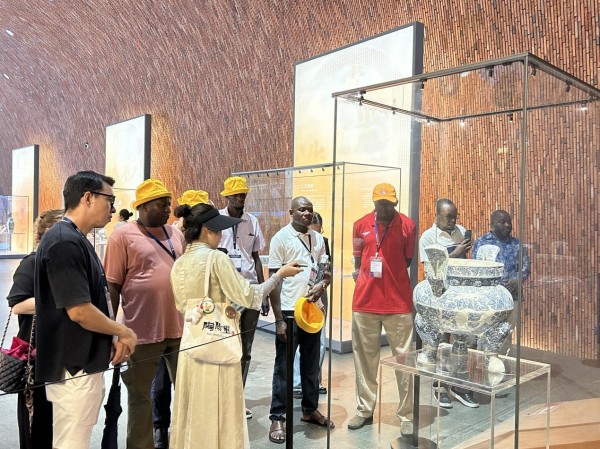
(Photo: Staff explaining to participants the Ming Dynasty Yongle blue-and-white tripod censer with waves and cliffs motif)
At the China Ceramics Museum, participants gained a systematic understanding of the development of Chinese ceramics and the cultural meanings behind various glazes and colors. Since ancient times, Jingdezhen ceramics have been exported overseas and served as important carriers of trade and cultural exchange along the ancient Silk Road, long becoming a distinct symbol of Chinese civilization. The Taoyangli Neighborhood exudes a long-standing ancient charm, with its streets and alleys themselves forming a living cultural heritage. Participants observed traditional porcelain-making techniques firsthand, learned about the rigorous standards for material selection, and through the thousand-year kiln fires and ancient craftsmanship methods, deeply felt the artisan spirit of dedication, focus, and the pursuit of perfection.
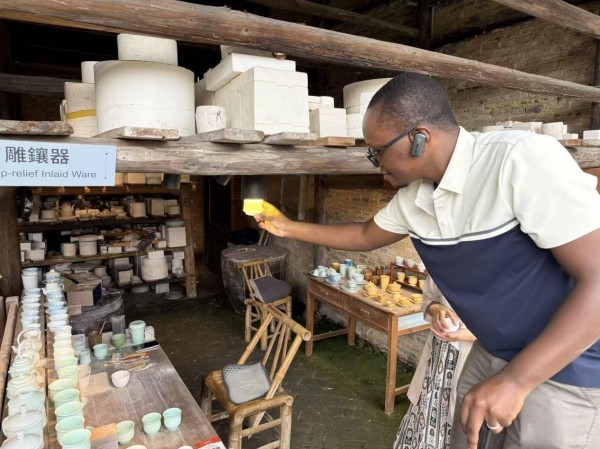
(Photo: Participants carefully studying ceramic works)
This study tour left a deep impression and strong resonance among the participants. Mr. Jumu Wally, Deputy Executive Secretary of the Gambia Public Enterprises Commission, remarked that without understanding the deeper meaning behind the culture, the ancient porcelain piece-paved roads would only be seen as ordinary. In fact, these streets and alleys are tangible, perceptible roots of civilization and a thousand years of history. Mr. Ahmet Bilen, an expert from the Ministry of Energy and Natural Resources of Turkey, noted that when appreciating the colorful glazed ceramics under the light, the varying thickness of the hand-applied glaze is clearly visible. It feels like a conversation across time with artisans from a thousand years ago, an amazing testament to the depth and power of culture that transcends time and space. Mr. Ousman Sanneh, Director of the Employment Services Division of the Ministry of Labour of Gambia, shared that the conch shell holds a significant place in Gambia, just as porcelain does in China — every country has its own objects that carry special meaning. The participants unanimously agreed that culture is the foundation of a nation's survival and development. While each country must maintain confidence in its own culture, it should also deepen civilizational exchange and mutual learning on the basis of preserving its unique heritage, working together to achieve shared prosperity.
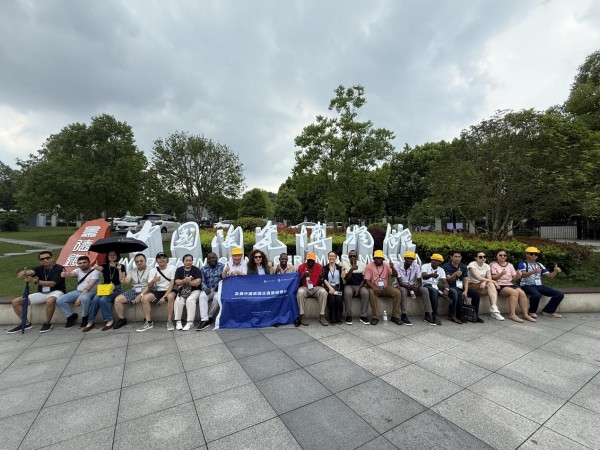
(Group photo of participants in front of the China Ceramics Museum)
Porcelain as a bridge, connecting the Silk Road. This Jingdezhen study tour was a practical initiative by the seminar to deepen cooperation through cultural exchange and support enterprise development through mutual learning among civilizations. Participants enhanced their mutual friendship through immersive experience. SBS will continue to use culture as a bond, build platforms for international exchange, promote the inheritance and dissemination of ceramic culture, and help countries deepen cooperation in areas such as cultural creativity, handicrafts, and trade, working together to pursue shared development.
Written by: Chen Xiaoye
Photograph by: Wang Xiao
Reviewed by: Chen Wei